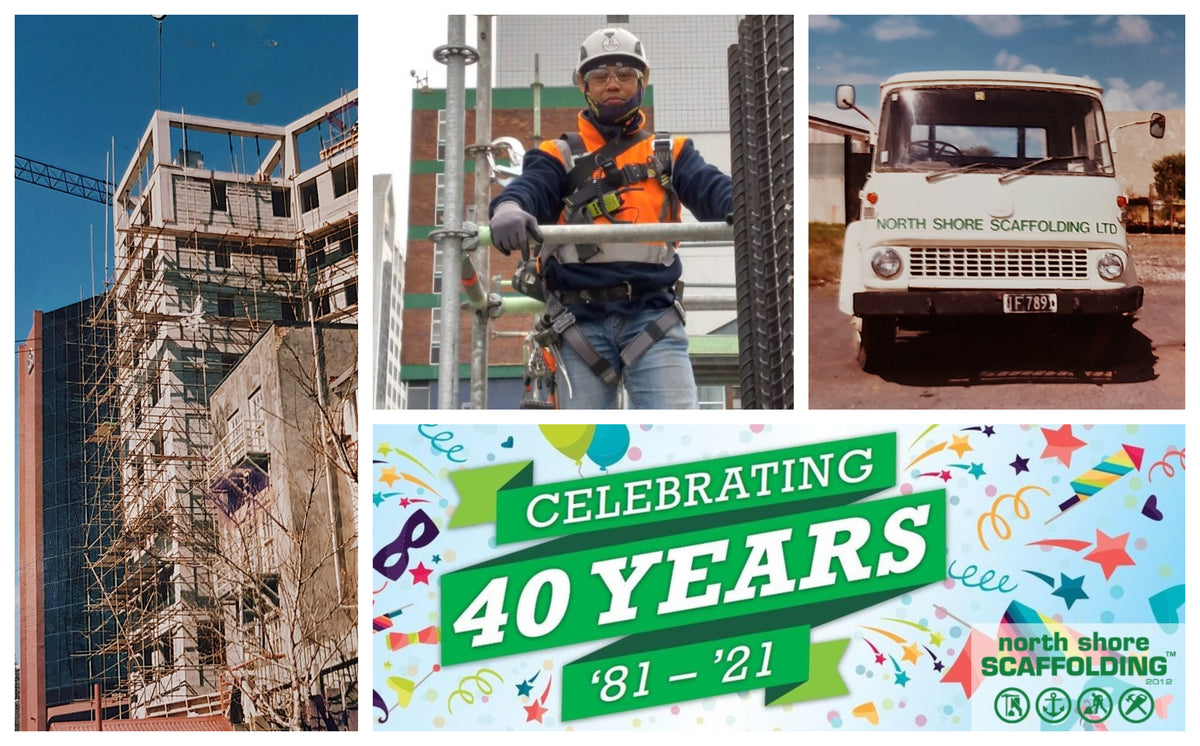
From the heavy 'black steel' tube-and-clip of 1981 to today's Layher system scaffolding, the gear, the trucks, the tools and the approach to health and safety have all changed enormously. Here's how the work has evolved across four decades.
The evolution of scaffolding
When Tony Webb started North Shore Scaffolding in 1981, the industry ran on what's commonly called "tube and clip." Heavy import tariffs meant only the fittings — made by a company called Burtons — were imported from England, while the tubes were made in New Zealand.
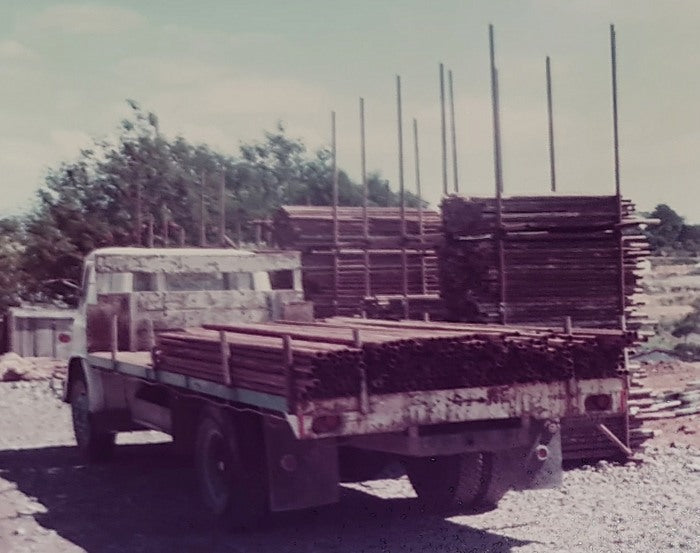
The tubing was 5-6 mm thick — heavy, compared with today's 3.2 mm galvanised tubes. And being black steel rather than galvanised, it rusted, leaving a brownish-black residue over everything. At the end of a day the crew's clothes, hands and anything they'd touched were stained — and it wasn't easy to get off.

In the late 1980s import tariffs were abolished, making it more economical to bring products into New Zealand — scaffolding among them. In 1998 the French built their America's Cup base from shipping containers and scaffolding, using a German system called Layher they'd brought over — but they needed a local company to erect it. Tony Webb saw the system, found it interesting, and bid for the job. It went to another company — but within a few years NSS began its own investment in Layher.
In the early 2000s NSS switched to Layher. The advantage of "system scaffolding" is that it's easier to teach, it looks tidier (fittings spaced at 500 mm intervals), and it's faster to erect and dismantle. Its engineered specifications let it be used across a huge range of scenarios. It demands that leading hands and supervisors be more organised and know exactly how much gear a plan needs — which we see as a positive.
About Layher
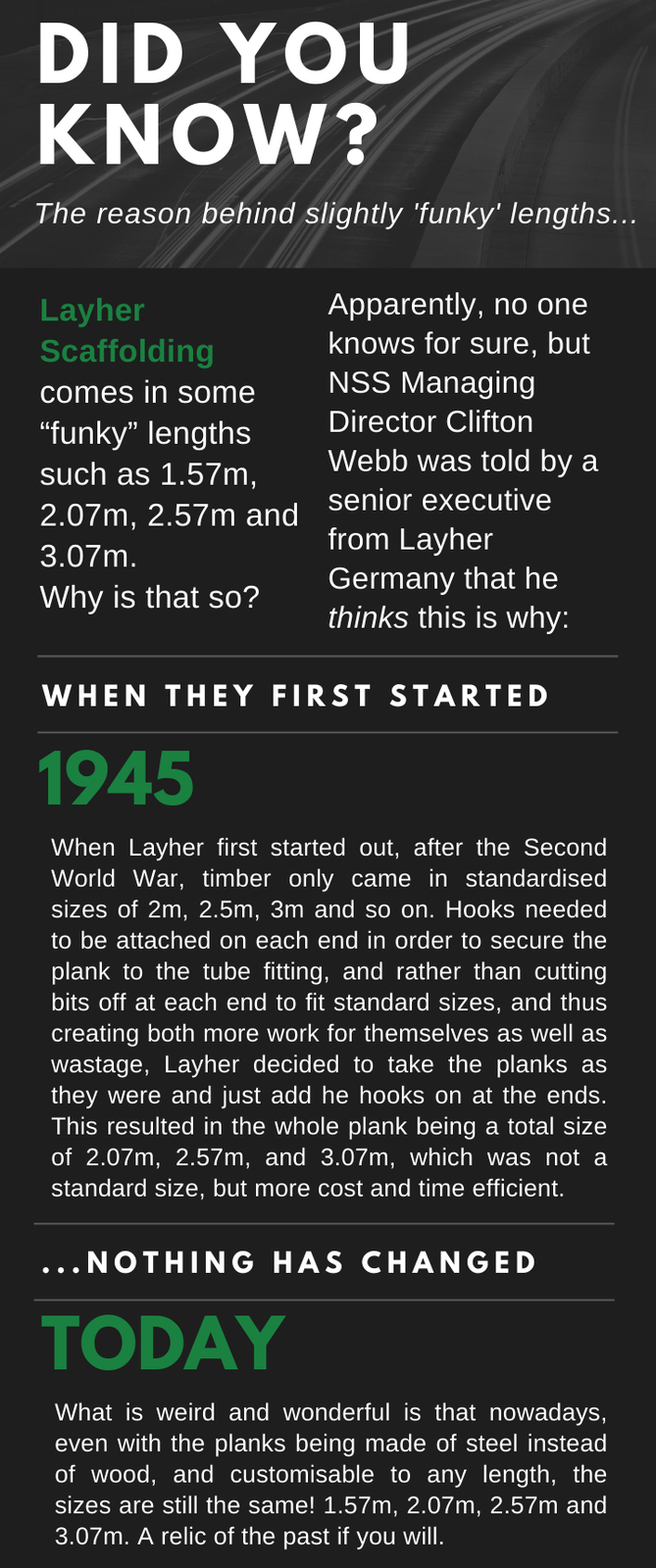
Layher is the world's leading designer, manufacturer and distributor of scaffolding and temporary access. The company began in Germany in 1945, when founder Wilhelm Layher made agricultural implements and ladders out of wood. During the post-war building boom he saw the need for construction scaffolding, and in 1948 specialised in ladder scaffolding. Today Layher has 1,900-plus employees across more than 140 locations in 80 countries. Made only in Germany, its systems are precision-manufactured to the most exacting standards — SpeedyScaf arrived in 1965 and Allround Scaffolding in 1974. Still 100% family-owned, Layher has New Zealand branches in Auckland and Wellington.
Changing the way we do things
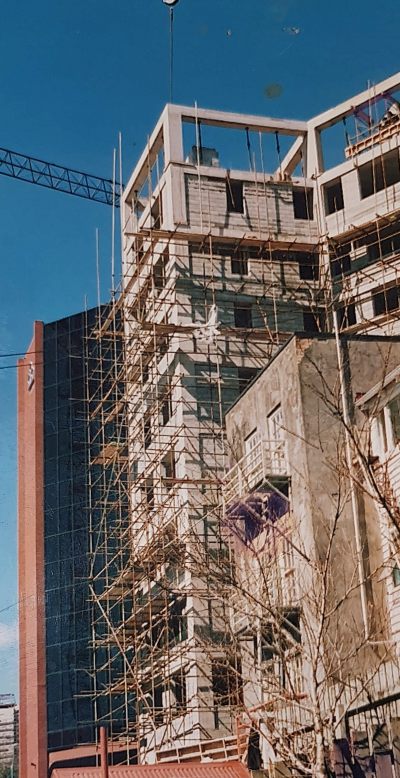
In the 1980s, NZ scaffolding companies typically supplied only the tubular skeleton; planks and kickboards, usually wooden, came from the construction company. On a 1983 job at the Smith & Caughey building in central Auckland, the client asked Tony Webb whether NSS could also supply the planks and kickboards. He agreed. When an OSH representative (the precursor to WorkSafe) visited, he was so impressed by the three-plank-wide walkways and kickboards NSS had provided that OSH made it compulsory for scaffolding companies to supply planks and kickboards from then on.
Early planks were NZ spruce — big, solid and heavy. But spruce grows too fast here, producing knotty timber that broke easily, so the 1980s saw a switch to more durable laminated boards. When NSS moved to Layher in the early 2000s, it also moved to metal planks. Wooden kickboards are still used today — the last bits of timber left on the scaffolds.
The use of trucks
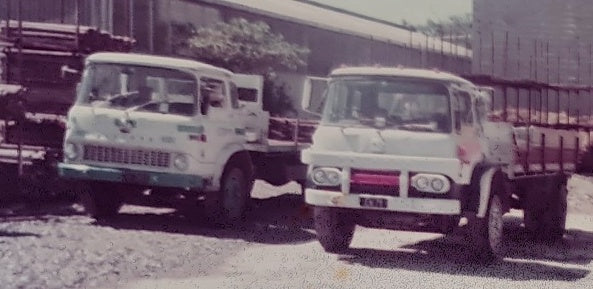
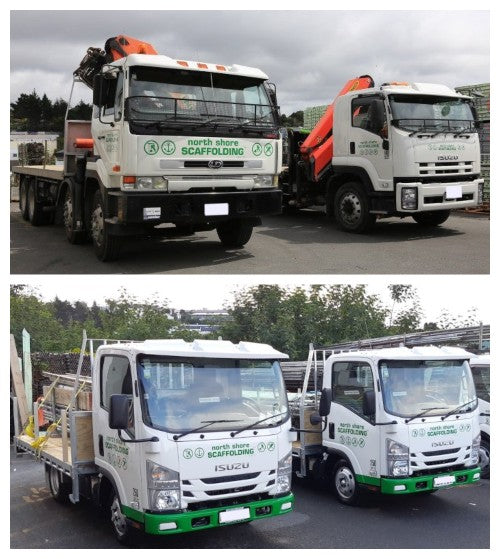
In the early days, scaffolders worked in teams of two, sharing one truck. Each morning a team loaded up and drove to site with whatever they reckoned they'd need — and sometimes a miscalculation meant driving back to the yard for more, losing valuable time. With eight trucks across 16-17 scaffolders, it's no wonder NSS had to contract in a mechanic just to service them all.
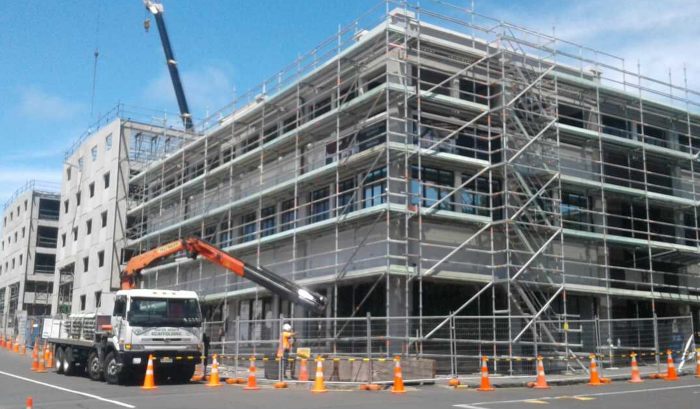
Today, with a bigger workforce and more varied jobs, NSS runs smaller light trucks and utes with teams of three. Scaffolding is no longer carted by the teams themselves — two large HIABs with drivers deliver gear when and where it's needed across Auckland, and yard staff manage loading, stock counts and maintenance. It's more efficient, and it lets people focus on what they do best: when the crew are on site, they're there to work, calling on the yard team when needed.
Scaffolders and their tools — improvements in health & safety
When Tony Webb started scaffolding, the whole toolkit was a 7/8th swing-over spanner and a yardstick. Today's scaffolders carry a level, hammer, tape measure, crescent wrench and ratchet spanner, among others.
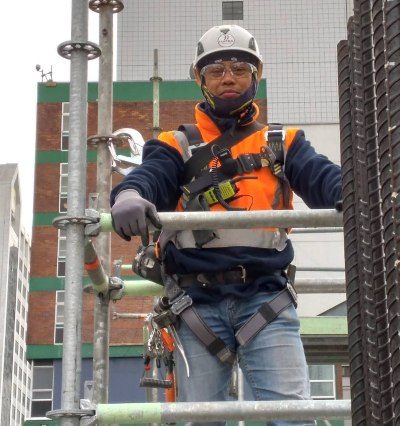
Work attire has changed just as much — from short shorts, singlets and optional footwear to today's safety-first standard. Crews wear high-vis shirts, steel-cap boots, and chin-strap hard hats that are really mountain-climber helmets, protecting against both falling debris and side impact.
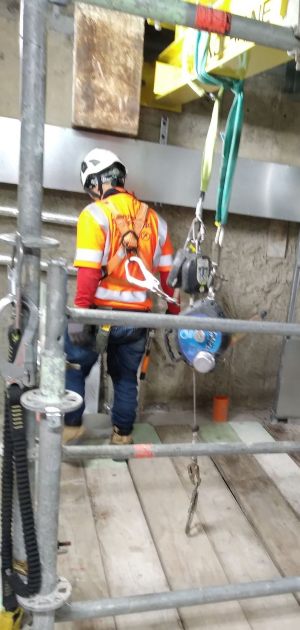
Among the most important safety gear are harnesses and lanyards. In the old days these were often shared and left in the truck "if needed" — i.e. if an inspector showed up. Today every scaffolder wears their own at all times, commonly twin retractable lanyards for fall restraint, with type 2 and type 3 rescue lanyards and static lines for live-edge work.
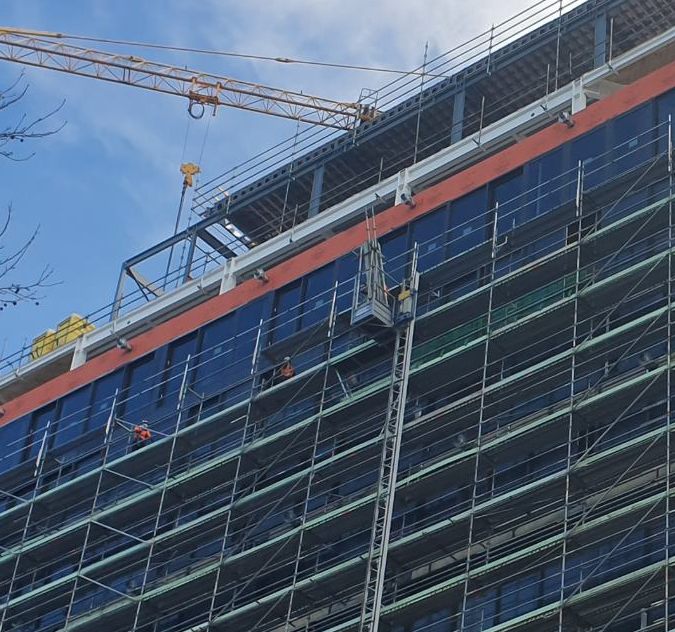
One of the biggest recent innovations is the move beyond harness-and-lanyard. Layher's Advanced Guardrail lets a scaffolder build to any height while always working behind a safety rail, effectively eliminating the live edge as a hazard. (Crews still wear harness and lanyard for the occasions the guardrail can't be used.)
Over 40 years, the industry has changed enormously. Technology has enabled larger and more complex scaffolds to help our cities grow — and, above all, has let scaffolders do their work far more safely. North Shore Scaffolding continues to drive that forward.